Any time of year
Christening & Baptism: History, Customs and Guest Etiquette 2026
Where Christian baptism comes from, how Catholic, Anglican, Orthodox and Baptist churches celebrate it, what godparents promise, and what guests should wear and give, plus messages and Bible verses.
Updated 6 messages 10 quotes Tap to copy any message
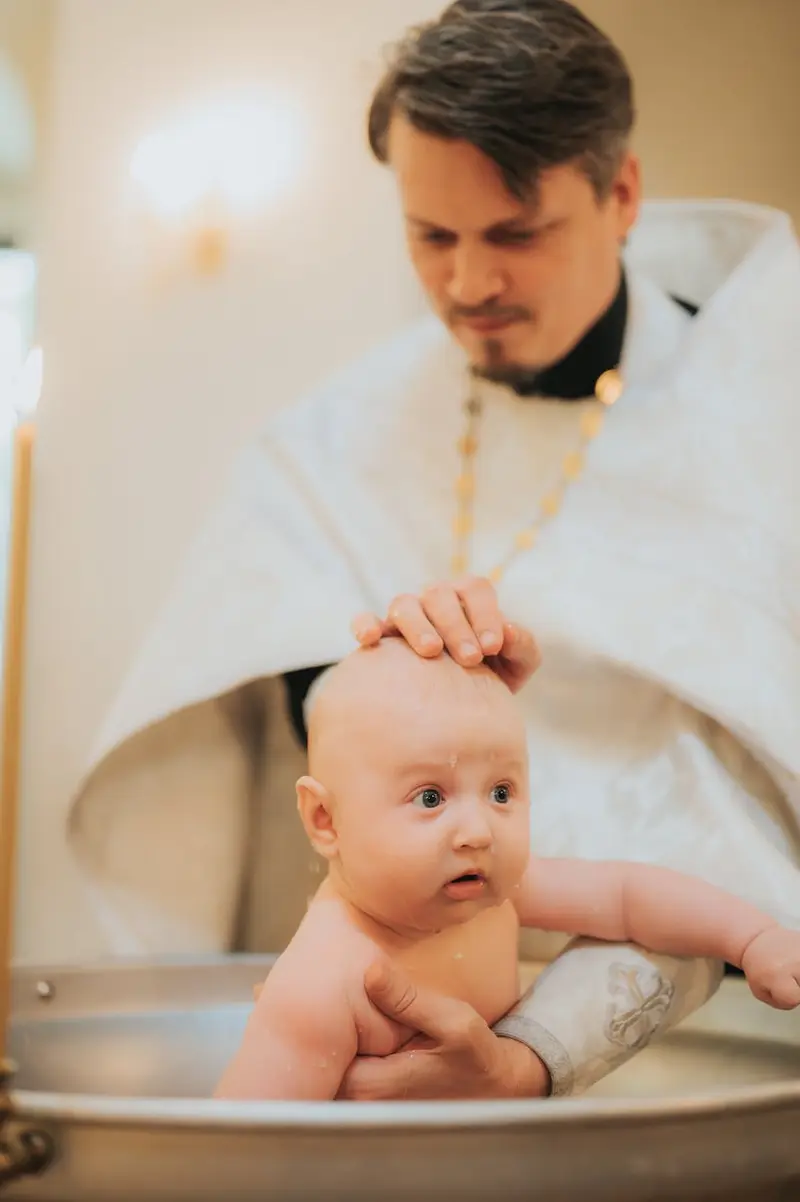
Baptism is the rite by which a person, often a baby, is received into the Christian Church with water “in the name of the Father, and of the Son, and of the Holy Spirit.” “Christening” is simply the older English name for the same service: the Church of England says plainly that “there is no difference between a christening service and a baptism service” (Church of England). How the water is used, who stands as godparent and what guests do afterwards depends a good deal on the church.
Where Baptism Comes From
Washing as a sign of a fresh start is older than Christianity. The Orthodox Church in America notes that ritual immersion was practised “among the people of the Old Testament” and that John the Baptist baptized people “as a sign of repentance” before Jesus himself was baptized by John in the Jordan (Orthodox Church in America).
The oldest surviving instructions are in the Didache, an early Christian church manual. It asks for baptism “in living water” (running water), allows other water, cold or warm, if none is available, and as a last resort says to “pour out water thrice upon the head into the name of Father and Son and Holy Spirit.” It also asks the person being baptized to fast for a day or two beforehand (Didache, ch. 7).
Infants and godparents. The Catholic Catechism says there is “explicit testimony” to infant baptism “from the second century on” (Catechism 1252). Sponsors appear early too. Around the year 200 the North African writer Tertullian argued for delaying the baptism of small children, partly because the “sponsors” who made promises for them might die or see the child turn out badly (Tertullian, On Baptism 18), which shows that godparents were already standing in for infants at that time.
From immersion to pouring. The 1907 Catholic Encyclopedia records that immersion “seems to have prevailed until the twelfth century” in the Western Church, and that pouring and sprinkling “were growing common in the thirteenth century and gradually prevailed” in the West, while the Eastern churches kept immersion (Catholic Encyclopedia).
The white gown. The white robe stands for having “put on Christ” (Galatians 3:27), as the Catechism explains (Catechism 1243). The Victoria and Albert Museum notes that by the early 19th century this had become “a long, white or cream robe,” and that “often the one dress was used for all the children in the family.” Queen Victoria’s children were all christened in the same Honiton lace robe, according to the Illustrated London News of 5 December 1874, quoted by the museum (V&A).
How Churches Differ
- Roman Catholic. Canon law asks parents to have infants baptized “in the first few weeks,” by immersion or pouring, ideally on a Sunday or at the Easter Vigil. The baby may have one godparent or two (one of each sex). A godparent must be at least 16 unless the bishop sets another age, a confirmed Catholic who has received Communion, and not the child’s parent. A baptized non-Catholic may stand only “as a witness,” alongside a Catholic godparent (Code of Canon Law, cann. 854–874). The rite includes the sign of the cross, anointing with chrism, the white garment and a candle lit from the Easter candle (Catechism 1235–1243).
- Church of England. The service is free and usually takes place during the Sunday service. Each child should have at least three godparents: two of the same sex as the child and one of the opposite sex. Godparents must be baptized (in any church) and preferably confirmed. Parents can be godparents, and proxies are not allowed (Church of England).
- Eastern Orthodox. The baby is immersed three times, then immediately chrismated (anointed with holy chrism, or myron) and given Communion. The newly baptized child is carried in procession three times around the font while “As many as have been baptized into Christ have put on Christ” is sung (Orthodox Church in America; Catechism 1233).
- Baptist. Baptists do not baptize infants. The Baptist Union of Great Britain’s Declaration of Principle, first adopted in 1873, defines baptism as “the immersion in water” of “those who have professed repentance towards God and faith in our Lord Jesus Christ” (Baptist Union of Great Britain).
Greek Orthodox Customs
The Greek Orthodox Community of Leeds’ christening guide lists what the godparent (nounos or nouna) traditionally brings: a full set of new white clothes for the baby, a gold cross and chain, the lathopana (a white sheet and towels), a large decorated candle (lambada), a small bottle of olive oil and a bar of soap. Guests receive koufeta, sugared almonds given in odd numbers, and martyrika, small “witness” pins showing that they saw the baptism (Greek Orthodox Community of Leeds).
Guest Etiquette: What to Expect
Before the day. Ask whether the baptism is part of the main Sunday service. In the Church of England it usually is (Church of England).
What to wear. The Church of England’s guest guide says “people usually wear something smart to the service because it’s a special occasion, but there’s no need to dress up specially” (Church of England).
During the service (Church of England). The vicar welcomes the family. Parents and godparents make promises, and a cross is often traced in oil on the child’s forehead. Water is poured over the child’s head with the words “I baptize you in the name of the Father, and of the Son, and of the Holy Spirit,” and a candle is given (Church of England). Guests have a spoken part. When the vicar asks “People of God, will you welcome these candidates and uphold them in their life in Christ?”, everyone answers “With the help of God, we will.” The vicar may invite a round of applause after the baptism (Church of England).
Gifts. The Church of England suggests a children’s Bible or Bible-story book, a book of prayers, jewellery with a cross or fish symbol, or a donation to a charity in the child’s name (Church of England). Godparents often give something lasting: in Greek families, the cross and the baptismal clothes are the godparent’s gift (see above). A card with a short blessing (see the messages below) is always appropriate.
If you are a godparent. Godparents are not legal guardians. That is arranged by a parent’s will (Church of England). The role is spiritual: in Catholic teaching, godparents must be “firm believers, able and ready to help the newly baptized” (Catechism 1255).
Messages
- “Congratulations on your little one’s baptism! May they always know how loved and welcomed they are.”
- “To the new godparents: thank you for the promises you made today. What a lucky child.”
- “Welcomed by water, wrapped in white and surrounded by family. A beautiful day for a beautiful baby.”
- “Wishing your family joy and blessings as your precious one is welcomed into the church.”
- “May the candle lit today keep shining in your child’s life. Congratulations on the christening.”
- “Na sas zisei! Wishing the newly baptised a long and happy life, and many thanks to the nouno and nouna.”
Quotes
- “Train up a child in the way he should go; even when he is old he will not depart from it. – Proverbs 22:6”
- “Children are a gift from the Lord; they are a reward from him. – Psalm 127:3”
- “Before I formed you in the womb I knew you, before you were born I set you apart. – Jeremiah 1:5”
- “For this child I prayed, and the Lord has granted me my petition that I made to him. – 1 Samuel 1:27”
- “Suffer the little children to come unto me, and forbid them not: for of such is the kingdom of God. – Mark 10:14”
- “For all of you who were baptized into Christ have clothed yourselves with Christ. – Galatians 3:27”
- “Go and make disciples of all nations, baptizing them in the name of the Father and of the Son and of the Holy Spirit. – Matthew 28:19”
- “The Lord bless you and keep you; the Lord make his face shine on you and be gracious to you. – Numbers 6:24-25”
- “Baptism is the beginning of the spiritual life, and the door of the sacraments. – Thomas Aquinas”
- “Children are the hands by which we take hold of heaven. – Attributed to Henry Ward Beecher”
FAQ
What’s the difference between a christening and a baptism? None in substance. The Church of England says the two services are the same: some churches say “christening,” others “baptism,” and the moment water is poured or wiped on the child’s head is the baptism itself (Church of England). The idea that a christening is only a naming ceremony is a myth.
At what age are children baptized? It depends on the church. Catholic canon law asks for baptism “in the first few weeks” after birth (can. 867). The Church of England sets no minimum or maximum age and says children of about 12 may be old enough to make the promises themselves (Church of England). Baptist churches baptize only people who profess faith for themselves.
How many godparents can a child have? In the Catholic Church, one or two (no more than one of each sex). In the Church of England, at least three, and three or four is usual. Anyone baptized can be a Church of England godparent, while a baptized non-Catholic can only be a witness at a Catholic baptism (cann. 873–874; Church of England).
Related Celebrations
As you celebrate Christening and Baptism, explore our guides for First Communion for future Catholic milestones, Confirmation for continued faith development, and Baby Shower for pre-birth celebrations. For religious observances, check our Easter and Christmas articles.