Mostly April and May
First Communion: History, Customs and Guest Etiquette 2026
Why Catholic children make their First Communion at about seven, how the custom differs in Ireland, Poland, Italy and the Eastern churches, and what guests should know about the Mass, dress and gifts, plus messages and quotes.
Updated 6 messages 9 quotes Tap to copy any message
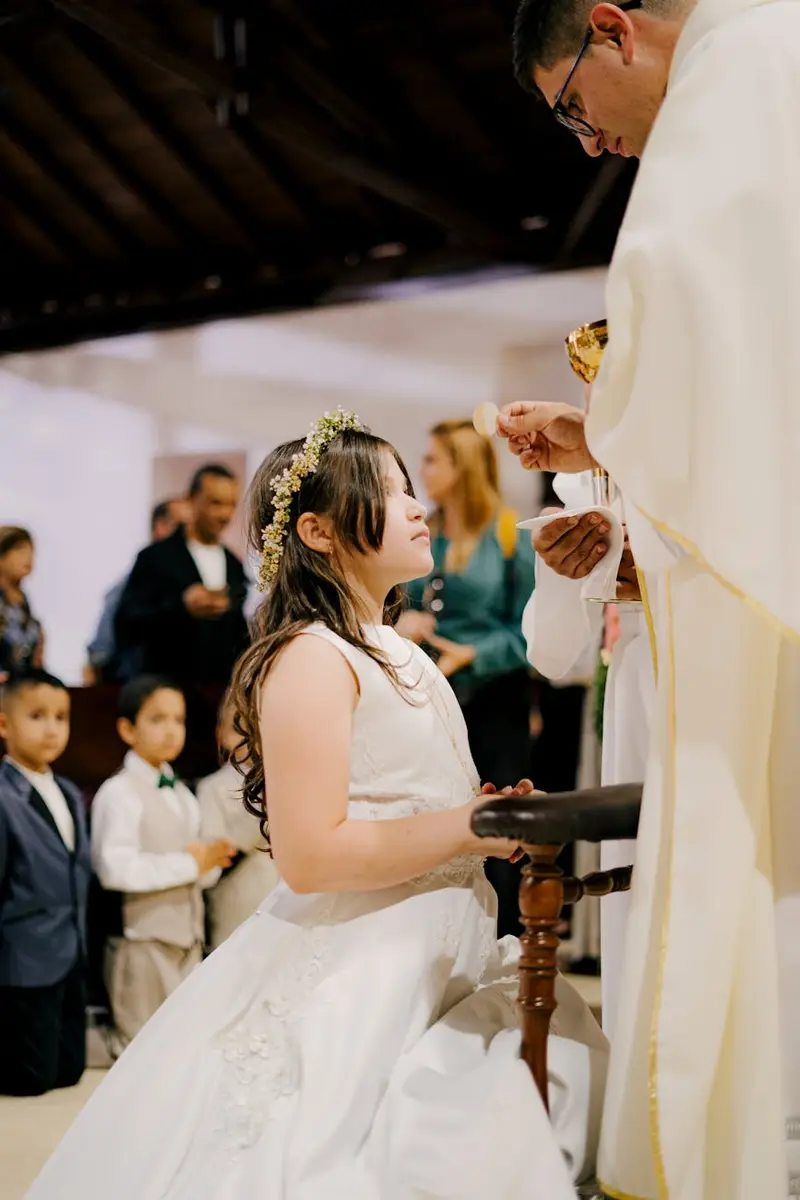
First Holy Communion is the first time a baptized Catholic child receives the Eucharist, usually at about seven, after a first confession. The age is fairly recent: until a decree of 1910, many places made children wait until ten, twelve or even fourteen (Quam Singulari).
Origin: From Infant Communion to the “Age of Discretion”
The 1910 decree itself recalls an “ancient practice of administering the Eucharist to children before they had attained the use of reason,” which “later died out in the Latin Church” (Quam Singulari). The Eastern Churches kept it: the Catechism notes that they give “Holy Communion to all the newly baptized and confirmed, even little children,” while the Latin (Western) Church “reserves admission to Holy Communion to those who have attained the age of reason” (Catechism 1244).
1215: the Fourth Lateran Council. Its Canon 21 required “all the faithful of both sexes” who had reached “the years of discretion” to confess at least once a year and to receive Communion at least at Easter. That “years of discretion” phrase became the benchmark for a first Communion in the West (Quam Singulari).
Before 1910: older and older. Over the following centuries, “owing to various local customs and opinions,” the age was set at “ten years or twelve, and in places fourteen years or even more.” The 1910 decree blamed this partly on the influence of the Jansenists, who treated the Eucharist as “a reward rather than a remedy for human frailty” (Quam Singulari).
1910: Quam Singulari. Under Pope Pius X, the Sacred Congregation of the Sacraments ruled that the age of discretion for both confession and Communion “is the time when a child begins to reason, that is about the seventh year, more or less,” and that “a full and perfect knowledge of Christian doctrine is not necessary” for either (Quam Singulari). This is why Catholic children in most countries now make their First Communion in the second or third year of primary school.
Today’s rules. Current canon law requires that children have “sufficient knowledge and careful preparation” so they can receive “with faith and devotion,” and that they make a sacramental confession first. Communicants fast for at least one hour beforehand (water and medicine excepted) (Code of Canon Law, cann. 913–919).
How Practice Differs
- Eastern Orthodox and Eastern Catholic churches. There is no separate “First Communion” day. Babies receive Communion at their baptism and chrismation, then regularly afterwards (Catechism 1233, 1244).
- Church of England. Under the Admission of Baptised Children to Holy Communion Regulations 2006, parishes with their bishop’s permission may give Communion to baptized children before confirmation. The General Synod described the change as giving children full involvement “before coming to Confirmation at a time more appropriate for them” (Church of England General Synod paper GS 1881A).
- German Protestants. Traditionally, Lutheran and Reformed young people took their first Communion at confirmation, around 14. The Protestant weekly Sonntagsblatt notes that since the late 20th century, baptism rather than confirmation is now usually the requirement (Sonntagsblatt).
Traditions in Catholic Countries
- Ireland: “Communion money.” Relatives and neighbours traditionally give the child cash. A 2010 EBS survey of 1,000 adults reported in The Irish Times found that about 60,000 children expected an average of €300 in cash gifts that season, and that the average gift adults considered fitting had fallen from €50 to €37 in a year (The Irish Times).
- Poland: a May–June season and big parties. TVN24 describes the spring “First Communion season” as one where many parents “set great store by communion attire, gifts and parties.” A March 2022 survey for the debt register KRD found 26.5% of families were ready to borrow to pay for the celebration. That same year, chalice-shaped piñatas at parties caused a public row (TVN24).
- Italy: plain white robes. Aleteia reports that in Italy simple white albs “have become the norm in many places,” partly so the focus stays on the sacrament rather than expensive clothes, and partly to recall the white baptismal garment (Aleteia).
- United States: the white dress and suit. The same article notes that in the US it is customary for children to wear “a fancy white dress or suit,” though some parishes are switching to robes (Aleteia).
Guest Etiquette: What to Expect
The Mass. First Communion takes place during a Mass, often with a whole parish or school class at once. Arrive early, because family pews fill fast, and expect the children to sit together and be the focus of the service.
Should guests receive Communion? The US bishops’ guidelines, printed in many missalettes, say Catholics should not be conscious of grave sin and “normally should have fasted for one hour.” Other Christians “are ordinarily not admitted,” although Orthodox Christians are asked to follow their own church’s rules. Non-Christians are welcomed but “we ask them to offer their prayers” instead (USCCB). If you are not receiving, you can simply stay in your seat.
What to wear. Wear what you would wear to a family wedding Mass in daytime. Leave white to the communicants, since white is their colour as a sign of baptism (Aleteia).
Photos. Ask the family what the parish allows during Mass before you take any.
Gifts. Religious keepsakes are traditional: a rosary, a children’s missal or Bible, a medal, or a cross. Cash in a card is the custom in Ireland (see the figures above).
Messages
- “Congratulations on your First Holy Communion! May this day be the first of many at the altar.”
- “So proud of you walking up the aisle today in white. May you always remember this morning.”
- “Wishing you a beautiful First Holy Communion filled with grace, joy, and God’s blessings.”
- “All those weeks of preparation, your first confession and now your first Communion: well done, and God bless you.”
- “To the godparents and grandparents in the front pew: thank you for helping this child get here.”
- “May Jesus, whom you received for the first time today, be your friend and guide always.”
Quotes
- “This is my body which is given for you: this do in remembrance of me. – Luke 22:19”
- “I am the bread of life: he that cometh to me shall never hunger; and he that believeth on me shall never thirst. – John 6:35”
- “Let the little children come to me, and do not hinder them, for the kingdom of heaven belongs to such as these. – Matthew 19:14”
- “Blessed are the pure in heart: for they shall see God. – Matthew 5:8”
- “Taking part in the Eucharistic sacrifice, which is the fount and apex of the whole Christian life, they offer the Divine Victim to God, and offer themselves along with It. – Second Vatican Council, Lumen Gentium 11”
- “Prayer is the raising of one’s mind and heart to God or the requesting of good things from God. – St. John Damascene”
- “I shall always remember my First Communion Day as one of unclouded happiness. – St. Thérèse of Lisieux”
- “How sweet was the first embrace of Jesus! It was indeed an embrace of love. – St. Thérèse of Lisieux”
- “Faith is taking the first step even when you don’t see the whole staircase. – Attributed to Martin Luther King Jr.”
FAQ
At what age do children make their First Communion? In the Latin Catholic Church, at the “age of discretion,” which the 1910 decree Quam Singulari put at “about the seventh year, more or less” (Quam Singulari). Sonntagsblatt notes it is usually celebrated at about seven (Sonntagsblatt). Eastern churches give Communion from infancy (Catechism 1244).
What preparation is required? Canon law asks for “sufficient knowledge and careful preparation” suited to the child’s ability, and a first confession beforehand (cann. 913–914). The 1910 decree stresses that the child does not need complete knowledge of doctrine (Quam Singulari).
Why do children wear white? White recalls the white garment given at baptism, the sign of having “put on Christ” (Catechism 1243; Aleteia). Some parishes, especially in Italy, use plain white robes instead of dresses and suits.
Can non-Catholic family members take Communion? Ordinarily not, under Catholic discipline. Guests are welcome at the Mass, and the US bishops invite those not receiving to pray for unity instead (USCCB).
When is First Communion season? There is no single date, and your parish sets the day. In Poland, for example, the season runs through May and June (TVN24).
Related Celebrations
As you celebrate First Communion, explore our guides for Confirmation for the next sacramental step, Christening and Baptism for earlier Catholic milestones, and Bar/Bat Mitzvah for other religious coming-of-age ceremonies. For Catholic celebrations, check our Easter and Christmas articles.