Mostly spring
Confirmation: History, Catholic and Protestant Customs, Guest Etiquette 2026
How confirmation split from baptism, what happens at a Catholic confirmation and a Lutheran Konfirmation, sponsors and confirmation names, the age rules, and what guests should wear and give, plus messages and quotes.
Updated 6 messages 10 quotes Tap to copy any message
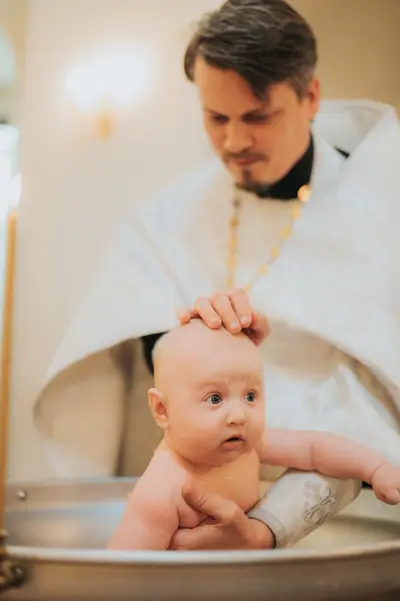
Confirmation is the rite in which a baptized Christian is anointed or blessed to “confirm” the gift of the Holy Spirit received at baptism. Catholics count it as a sacrament, and many Protestant churches as a public profession of faith. In the first centuries it was not a separate event at all: it was part of baptism, and the Eastern Orthodox churches still give it to babies in the same service (Catechism 1290).
Origin: How Confirmation Became Its Own Day
One rite, then two. The Catechism explains that “in the first centuries Confirmation generally comprised one single celebration with Baptism,” which St Cyprian called a “double sacrament.” As infant baptisms spread through the year and dioceses grew, the bishop could not attend every baptism. In the West, the wish to keep the completion of baptism for the bishop “caused the temporal separation of the two sacraments.” The East kept them together, so an Orthodox priest confirms (chrismates) at baptism, using chrism (myron) consecrated by a bishop (Catechism 1290–1292).
The medieval and pre-1971 rite. The Catholic Encyclopedia (1908) describes the older Latin form. The bishop anointed each forehead with chrism, saying “I sign thee with the sign of the cross and confirm thee with the chrism of salvation,” and then gave “a slight blow on the cheek saying: ‘peace be with thee’” (Catholic Encyclopedia). Pope Paul VI’s apostolic constitution Divinae Consortium Naturae (1971) set the present words, “Be sealed with the Gift of the Holy Spirit” (Catechism 1300).
The Protestant Konfirmation. For Lutheran and Reformed churches, confirmation is not a sacrament but a young person’s own “yes” to the promises made for them at baptism. Sonntagsblatt, the Bavarian Protestant weekly, traces it to 1539, when the reformer Martin Bucer brokered a compromise in Ziegenhain, in northern Hesse, during a dispute over when Protestants should be baptized: infant baptism stayed, but young people would also make a profession of faith. The practice spread across Germany’s Protestant churches in the 18th century (Sonntagsblatt).
What Happens at a Catholic Confirmation
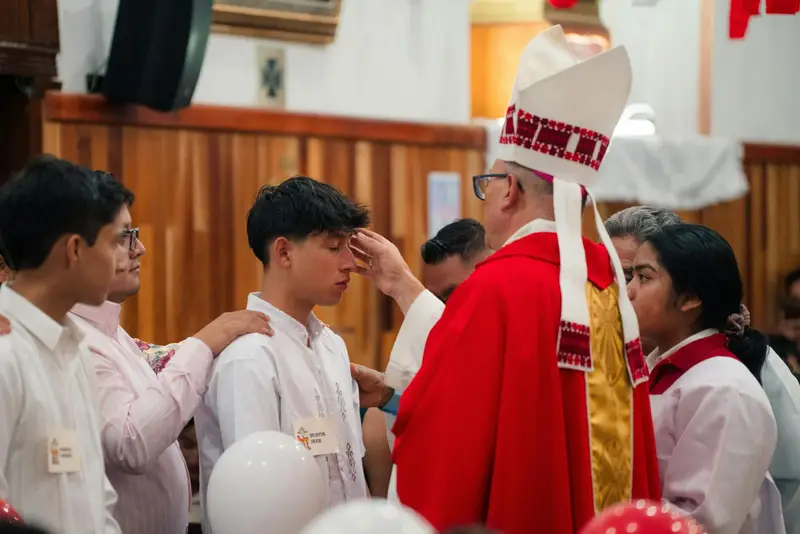
- Who confirms. The ordinary minister is a bishop. A priest may confirm with the faculty to do so, for example when receiving an adult convert (Code of Canon Law, can. 882).
- Renewal of baptismal promises and the profession of faith, then the bishop “extends his hands over the whole group” and prays for the outpouring of the Spirit (Catechism 1298–1299).
- The anointing. The bishop lays his hand on them and anoints the forehead with chrism, saying “N., be sealed with the Gift of the Holy Spirit.” The rite ends with the sign of peace (Catechism 1300–1301).
- Eastern contrast. In Orthodox and Eastern Catholic chrismation, the priest anoints “forehead, eyes, nose, ears, lips, breast, back, hands, and feet,” each time saying “The seal of the gift that is the Holy Spirit” (Catechism 1300; Orthodox Church in America).
Sponsors. Each candidate should have a sponsor who meets the same conditions as a baptismal godparent: at least 16, a confirmed and practising Catholic, and not the candidate’s parent. The Church says it is “desirable” to choose one of the baptismal godparents (cann. 874, 892–893; Catechism 1311).
Confirmation names. Taking a saint’s name is a custom, not a rule. U.S. Catholic traces it to at least the 16th century and notes that “choosing a new saint name at confirmation isn’t mandated.” Some dioceses now encourage candidates to keep their baptismal name to stress the link between the two sacraments (U.S. Catholic).
The Age Question
Canon law sets confirmation “at about the age of discretion” (around seven) unless the bishops’ conference decides otherwise (can. 891). The result varies a great deal:
- United States. The US bishops’ norm, effective 1 July 2002, says confirmation is conferred “between the age of discretion and about sixteen years of age,” within limits each diocesan bishop sets (Adoremus, text of the USCCB norm). In practice some dioceses confirm in primary school and others in the teenage years. As far back as 1897, Pope Leo XIII praised the practice of confirming children before their First Communion as closer to ancient usage (Catholic Encyclopedia).
- Germany. Catholic Firmung is usually at 16 to 18, while Protestant Konfirmation is usually at about 14, the age at which German law treats young people as able to choose their own religion (Sonntagsblatt).
Traditions Around the World
- Germany: Palm Sunday and a Bible verse. Palm Sunday was long the traditional Konfirmation Sunday, because it coincided with leaving school and starting an apprenticeship. In 2021, 149,642 people were confirmed in Germany. In the service, each young person is called by name, their chosen Konfirmationsspruch (a Bible verse) is read out, and the pastor lays hands on them in blessing. Traditional gifts were a first Bible or hymnbook, a small cross or fish pendant, and a confirmation candle (Sonntagsblatt).
- Eastern Germany: Jugendweihe and Lebenswende. The secular Jugendweihe, which was practised almost universally in the former GDR, has stayed popular since reunification. Since the late 1990s, Protestant and Catholic churches in the eastern states have offered ecumenical Lebenswende (“life-turning”) ceremonies for teenagers who belong to no church (Sonntagsblatt).
- Norway: humanist confirmation. Norway has a secular alternative to church confirmation, founded in 1951 by Kristian Horn, who believed such traditions should not be limited to believers. The Norwegian Humanist Association’s course covers critical thinking, ethics, identity, human rights and philosophy of life, and ends in a ceremony (Human-Etisk Forbund).
Guest Etiquette: What to Expect
The service. A Catholic confirmation is usually celebrated within Mass by the bishop, often for a whole parish group at once. If you are not Catholic, follow the guidelines on Communion that apply at any Mass: other Christians “are ordinarily not admitted,” and non-Christians are invited to pray (USCCB).
What to wear. Dress as for a formal church service. For the confirmand, Sonntagsblatt describes a German Konfirmation as the day of the first real suit or a special confirmation dress (Sonntagsblatt). Parishes sometimes set a dress code for candidates, so check before buying.
If you are the sponsor. You present the candidate and help them keep the promises made, and canon law expects you to “take care that the confirmed person behaves as a true witness of Christ” (can. 892).
Gifts. Traditional choices are a Bible, a cross or medal of the confirmation saint, a candle, or a book of prayers (Sonntagsblatt). A card that names the saint or the chosen Bible verse is a personal touch.
Messages
- “Congratulations on your Confirmation! May the Holy Spirit guide you throughout your faith journey.”
- “On the day you chose your confirmation name, may that saint walk with you always.”
- “To your sponsor: thank you for standing beside them today, hand on shoulder.”
- “Congratulations! Today you said ‘yes’ for yourself to the promises made for you at your baptism.”
- “May the gifts of the Holy Spirit you prayed for today, wisdom and courage above all, stay with you.”
- “Herzlichen Glückwunsch zur Konfirmation! May your confirmation verse go with you for life.”
Quotes
- “But the Advocate, the Holy Spirit, whom the Father will send in my name, will teach you all things. – John 14:26”
- “Be sealed with the Gift of the Holy Spirit. – Rite of Confirmation”
- “Do not be afraid. Open wide the doors for Christ. – Pope John Paul II”
- “As Christ is the Head of the Church, so is the Holy Ghost her soul. – Pope Leo XIII”
- “You are the light of the world… let your light shine before others. – Matthew 5:14, 16”
- “But you will receive power when the Holy Spirit comes on you. – Acts 1:8”
- “But when he, the Spirit of truth, comes, he will guide you into all the truth. – John 16:13”
- “Now to each one the manifestation of the Spirit is given for the common good. – 1 Corinthians 12:7”
- “But the fruit of the Spirit is love, joy, peace, forbearance, kindness, goodness, faithfulness, gentleness and self-control. – Galatians 5:22-23”
- “Come, Holy Spirit, fill the hearts of your faithful and kindle in them the fire of your love. – Traditional Prayer”
FAQ
At what age is confirmation? In Catholic canon law, “at about the age of discretion” unless the bishops’ conference sets another age (can. 891). In the US that means anywhere from about seven to about 16, depending on the diocese (Adoremus). German Protestants are usually confirmed at about 14 (Sonntagsblatt). Orthodox Christians are chrismated at baptism.
Do I have to choose a confirmation name? No. It is a long-standing custom rather than a requirement, and some dioceses encourage keeping the baptismal name (U.S. Catholic).
Who can be a confirmation sponsor? A Catholic of at least 16 who is confirmed, has received Communion, lives the faith and is not the candidate’s parent. The Church prefers one of the baptismal godparents (cann. 874, 893).
Can adults be confirmed? Yes. Any baptized Catholic not yet confirmed “can and should” receive the sacrament (Catechism 1306). Adults baptized at the Easter Vigil are confirmed in the same ceremony (Catechism 1233).
Related Celebrations
As you celebrate Confirmation, explore our guides for First Communion for earlier Catholic milestones, Christening and Baptism for Christian initiation, and Bar/Bat Mitzvah for other religious coming-of-age ceremonies. For Christian celebrations, check our Easter and Christmas articles.