
March 9–11, 2027 (expected) · in 120 days
Eid al-Fitr: How the Date Is Set, Eid Morning, Kahk Recipe & Greetings 2027
How the Shawwal moon sets the date of Eid al-Fitr, what happens on Eid morning from zakat al-fitr to the prayer, how Eid is kept in Indonesia, Malaysia, Pakistan and Egypt, a kahk cookie recipe, plus messages and verses.
Updated 7 messages 8 quotes Tap to copy any message
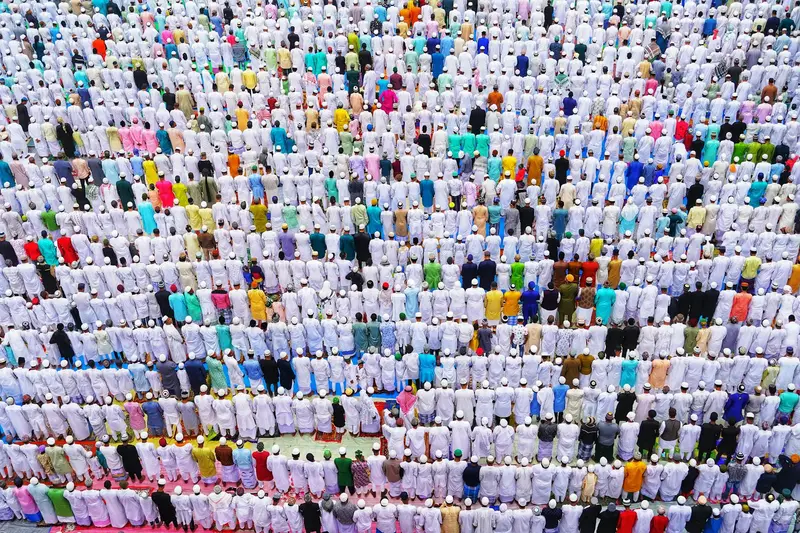
Eid al-Fitr, the “Festival of Breaking the Fast”, falls on the first day of Shawwal, the month after Ramadan, and begins when the new crescent moon is sighted. Its day is famously hard to predict: it can only be confirmed the evening before. In Indonesia it sets off a mass journey home: the transport ministry forecast 193.6 million homecoming travellers in 2024 (Katadata, citing the Ministry of Transportation).
Disclaimer: This content is for informational purposes only and does not constitute religious advice. Please consult with Islamic scholars or religious authorities for guidance on religious practices.
Where Eid al-Fitr Comes From
Islam has two canonical Eids, al-Fitr and al-Adha. A hadith in the collection of Abu Dawud relates that when the Prophet Muhammad arrived in Medina he found people celebrating two pre-Islamic festival days, and told them God had given them something better: “the Day of al-Adha and the Day of al-Fitr” (Quranic Tarbiyah lesson on Eid salah). The first Eid al-Fitr is dated to 624 CE (BBC Religion). The Quranic basis is the end of the fasting passage, which tells believers to “complete the prescribed period and proclaim the greatness of Allah for guiding you” (Quran 2:185, Quran.com). That is why the takbir (“Allahu akbar…”) is recited on the way to the Eid prayer.
How the Date Is Set
- The 29th of Ramadan. On the evening of the 29th day of the fast, people look for the Shawwal crescent. If it is sighted, Eid is the next day. If not, Ramadan completes 30 days and Eid follows.
- Whose sighting counts. Most Muslims rely on news of an official sighting rather than looking themselves (BBC Religion). Some communities accept only a sighting in their own country, some follow Saudi Arabia, and the Fiqh Council of North America uses astronomical calculation (BBC Religion). Families in the same city can therefore celebrate on different days.
- How long it lasts. Eid itself is the first of Shawwal, but celebrations and public holidays typically run for one to three days depending on the country. In Pakistan, for example, it is kept as a three-day festival (Arab News).
Eid Morning, Step by Step
- Pay zakat al-fitr before the prayer. This obligatory charity exists so that poor Muslims can also enjoy Eid. The measure given by the Prophet is one sa’ of food, about four double handfuls, per person, and a head of household also pays for the children in their care. Charities such as the UK’s National Zakat Foundation publish a recommended cash equivalent each year (National Zakat Foundation), but the figure is set locally, so check with your mosque.
- Prepare. Bathe, use a siwak (tooth stick), put on your best clothes and perfume, and eat an odd number of dates or something else before leaving. On Eid al-Adha people eat afterwards instead (Quranic Tarbiyah).
- Go to the prayer reciting takbir. Many walk to the prayer by one route and return by another (Quranic Tarbiyah).
- The Eid prayer. It is held shortly after sunrise in an open space or a mosque, with no call to prayer (adhan) beforehand. It has two units (rak’ahs) with extra takbirs, and the imam gives a sermon (khutbah) after the prayer (Quranic Tarbiyah). The number of extra takbirs differs between schools of law, so follow the imam.
- Greet everyone. “Eid Mubarak” (blessed Eid) or Taqabbal Allahu minna wa minkum, “May Allah accept from us and from you” (Quranic Tarbiyah). Then comes the first daytime meal in a month (BBC Religion).
How Eid Is Kept Around the World
- Indonesia: mudik and Lebaran. Before Lebaran (Eid), city workers head back to their home towns, a journey called mudik. In 2024 the transport ministry forecast that Central Java alone would receive 61.6 million travellers, followed by East Java and West Java (Katadata).
- Malaysia: Hari Raya Aidilfitri. Malaysians “balik kampung” (return to the home village), buy new baju Raya outfits, and after the morning Solat Aidilfitri hold open houses for relatives, friends and neighbours with rendang, ketupat (rice cooked in woven palm-leaf packets), lemang and kuih (Sabah State Library).
- Pakistan: Chand Raat. The night the moon is announced becomes a night market. In Karachi’s Gulf Market more than a thousand henna artists book stalls, set up only for the last two nights of Ramadan, or just one if the month runs 29 days (Arab News). In Peshawar, Qissa Khwani and Meena bazaars stay open late with glass bangles and Peshawari chappals (APP).
- Egypt: kahk. In the last days of Ramadan, families gather to make kahk, butter cookies stuffed with dates, nuts or malban and stamped with a patterned tool. Accounts trace the custom to Tulunid bakers. In 1124 the Fatimid caliph is said to have set aside 20,000 dinars to bake kahk for the feast, and a bakery called dar al-fitra was set up for it. Kahk packets from the 14th and 15th centuries, printed with “eat and give thanks”, survive in Cairo’s Museum of Islamic Art (Egypt Independent).
Recipe: Egyptian Kahk (about 30 cookies)
Ingredients
- 3 cups (375 g) plain flour
- 1 cup (225 g) ghee or clarified butter
- 1 tbsp toasted sesame seeds
- 1 tsp kahk spice, or 1/2 tsp ground mahlab plus 1/2 tsp ground cardamom
- 1 tsp instant yeast and 1 tbsp sugar
- 1/2 cup (120 ml) lukewarm milk
- Filling: 200 g date paste (agameya) kneaded with 1 tsp ghee and a pinch of cinnamon, or chopped walnuts mixed with a little honey
- Powdered sugar for dusting
Method (about 2 hours including resting)
- Mix the flour, sesame and spice in a large bowl. Heat the ghee until hot but not smoking, pour it over the flour and rub it in with your fingertips until it looks like damp sand. Leave to cool for 30 minutes.
- Stir the yeast and sugar into the milk, add to the flour and knead briefly into a soft, smooth dough. Don’t overwork it. Cover and rest for 30 minutes.
- Roll the filling into small balls about the size of a hazelnut.
- Take walnut-sized pieces of dough, flatten each in your palm, wrap it around a ball of filling and roll smooth. Flatten slightly and decorate with a kahk stamp, or pinch a pattern with clean tweezers (mona’ash) or the tines of a fork.
- Leave on lined trays for 20 minutes, then bake at 350°F (180°C) for 15–20 minutes until the bases are pale golden. The tops should stay light.
- Cool completely on the tray, as they are fragile when hot, then dust generously with powdered sugar. Stored airtight, they keep for two weeks.
Etiquette for Eid
- Eidi. Elders give children cash, usually crisp new notes in an envelope. If you are a guest in a family home, a small envelope for the children is always appreciated.
- Visiting. The first day is for the prayer and close family, especially elderly relatives. Visits to friends and open houses often continue for days.
- Attending the prayer as a visitor. Wear modest, clean clothes that cover arms and legs. Women usually cover their hair in the prayer area. Arrive early, because Eid congregations are among the largest of the year.
- Saying it. “Eid Mubarak” works for everyone. Cards and messages are best sent the evening the moon is announced or on Eid morning.
Joyful Eid al-Fitr Messages
- “Taqabbal Allahu minna wa minkum. May Allah accept our fasting and prayers. Eid Mubarak!”
- “Eid Mubarak! May the moon you waited for bring a blessed morning, a full mosque and a table of kahk.”
- “Selamat mudik! May your Lebaran trip home be safe. Mohon maaf lahir dan batin.”
- “Thirty days of fasting, one joyful morning. Eid Mubarak to you and your family!”
- “Selamat Hari Raya Aidilfitri! May your open house be full of friends and your ketupat never run out.”
- “Chand Raat Mubarak! May your mehndi be dark, your bangles bright and your Eid joyful.”
- “Eid Mubarak to our neighbours! Thank you for sharing your iftars with us this Ramadan.”
Beautiful Eid Quotes and Blessings
- “Allah intends for you ease and does not intend for you hardship and [wants] for you to complete the period and to glorify Allah for that [to] which He has guided you; and perhaps you will be grateful. – Quran 2:185”
- “For indeed, with hardship [will be] ease. Indeed, with hardship [will be] ease. – Quran 94:5–6”
- “In the bounty of Allah and in His mercy, in that let them rejoice; it is better than what they accumulate. – Quran 10:58”
- “Whoever does righteousness, whether male or female, while he is a believer, We will surely cause him to live a good life. – Quran 16:97”
- “He has certainly succeeded who purifies himself and mentions the name of his Lord and prays. – Quran 87:14–15”
- “O Abu Bakr! There is an Eid for every nation and this is our Eid. – Sahih al-Bukhari 952”
- “There are two pleasures for the fasting person, one at the time of breaking his fast, and the other at the time when he will meet his Lord. – Sahih al-Bukhari 1904”
- “He who observed the fast of Ramadan and then followed it with six fasts of Shawwal, it would be as if he fasted perpetually. – Sahih Muslim 1164”
FAQ About Eid al-Fitr
When is Eid al-Fitr 2027? Eid al-Fitr 2027 is expected to begin on Tuesday, March 9, 2027. The exact date depends on moon sighting and may vary by location.
Why isn’t the date of Eid known in advance? Eid begins with the sighting of the new moon at the end of Ramadan (BBC Religion), and a month can last 29 or 30 days. Communities that use astronomical calculation, such as the Fiqh Council of North America, can announce the date early. Those that wait for a sighting confirm it only the evening before.
What is zakat al-fitr and how much is it? An obligatory charity of one sa’ of staple food per person, paid before the Eid prayer so that poorer Muslims can celebrate too. Charities such as the UK’s National Zakat Foundation publish a yearly cash equivalent (National Zakat Foundation); amounts are set locally, so check with your mosque.
What is the difference between Eid al-Fitr and Eid al-Adha? Eid al-Fitr ends the Ramadan fast and is marked by zakat al-fitr before the prayer. Eid al-Adha, about ten weeks later during the Hajj season, is marked by an animal sacrifice (qurbani) after the prayer (Quranic Tarbiyah).
Can non-Muslims join Eid celebrations? Yes. Malaysian open houses welcome relatives, friends and neighbours (Sabah State Library), and many families everywhere welcome guests. Bring sweets or fruit and say “Eid Mubarak”.
Related Celebrations
Explore more with our guides on Ramadan, Diwali, and Chinese New Year, another festival known for its great homecoming journey.
Related holidays
February 8
Ramadan: How the Month
April 22
Passover: Seder
February 17
National Random Acts of Kindness Day
April 10
National Siblings Day