
Sunday, February 28, 2027 · in 111 days
National Science Day: C.V. Raman, the Raman Effect & How India Marks It 2027
Why India marks National Science Day on February 28: C.V. Raman's 1928 discovery of the Raman effect in Calcutta, how the day was designated, the open days held at Raman's institutes, a sea-colour experiment you can try, plus messages and quotes.
Updated 6 messages 8 quotes Tap to copy any message
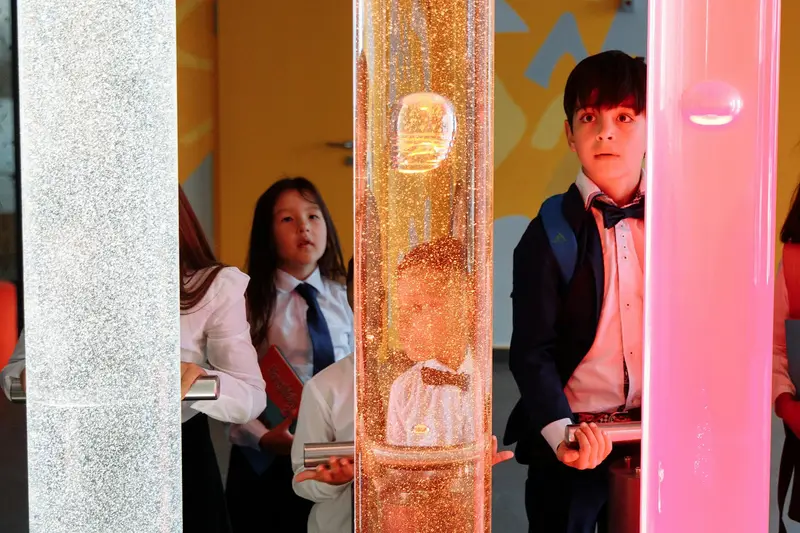
National Science Day is India’s national celebration of science, held every year on February 28. It marks the day in 1928 when C.V. Raman, working with K.S. Krishnan in Calcutta (now Kolkata), discovered that a small part of the light scattered by a liquid comes out a different colour. The finding, now called the Raman effect, won Raman the 1930 Nobel Prize in Physics.
The Discovery Behind the Date
Calcutta, 28 February 1928. Raman had been studying how molecules scatter light since the early 1920s. Its first sign was a short letter to Nature in 1921, “The Colour of the Sea”. In it he questioned Lord Rayleigh’s view that the deep blue of the sea “is simply the blue of the sky seen by reflection.” Raman’s test was to look at the water through a Nicol prism, a polarising filter that cuts out the reflected skylight, so that only the water’s own colour remained. The Nobel Foundation’s biography traces a line from his 1922 work on the “Molecular Diffraction of Light” to his discovery “on the 28th of February, 1928, of the radiation effect which bears his name” (NobelPrize.org).
The research was done at the Indian Association for the Cultivation of Science (IACS) in Calcutta. Assisted by K.S. Krishnan, Raman found “that when a beam of coloured light entered a liquid, a fraction of the light scattered was of a different colour, dependent on material property.” An IEEE Milestone plaque, dedicated in 2012, now marks the spot at the IACS main gate (IEEE Milestone, Engineering and Technology History Wiki). Raman and Krishnan announced the result in Nature as “A New Type of Secondary Radiation”. They reported that whenever light is scattered by molecules in dust-free liquids or gases, the ordinary scattered light “is accompanied by a modified scattered radiation of degraded frequency.”
Why it matters. The Nobel Prize was awarded to Raman alone, “for his work on the scattering of light and for the discovery of the effect named after him.” As the Nobel Foundation explains, some of the incoming light’s energy passes to the molecule, so the scattered light comes out at a different wavelength. Every substance does this in its own way, which is why Raman spectroscopy is used to analyse materials (NobelPrize.org).
How February 28 became National Science Day. In 1986 the National Council for Science and Technology Communication (NCSTC) asked the Government of India to designate February 28 as National Science Day. The government agreed that year, and the first National Science Day was observed on February 28, 1987 (High Commission of India, Mombasa).
How the Day Is Marked
- Open days at Raman’s institutes. Raman later became a professor at the Indian Institute of Science in Bangalore (1933–1948). In 1948 he founded and endowed his own Raman Research Institute in the city (NobelPrize.org). The Raman Research Institute holds a public Open Day on National Science Day that draws school students to its campus in Sadashivanagar (RRI Science Outreach). IISc holds its own annual Open Day “in conjunction with” National Science Day and its Founder’s Day, on the Saturday closest to March 3, Jamsetji Tata’s birthday. On that day the institute opens its laboratories to the public (IISc).
- Kolkata, where it happened. The IEEE Milestone plaque at the IACS entrance on Raja Subodh Mullick Road records the 1928 discovery (ETHW).
- Its stated purpose. The day is meant to spread a message about the importance of science in people’s daily lives and to showcase work done in science for the benefit of humanity (High Commission of India, Mombasa).
Try It: See the Sea’s Own Colour, Raman’s Way
Raman’s 1921 trick for separating a water body’s own colour from the reflected sky needs only polarising sunglasses. They do the job of his Nicol prism.
- Pick the conditions. Choose a sunny day with clear skies and a lake, a calm sea or a deep pool. Stand with the sun high and behind you, which is how Raman describes the observation.
- Find the polarising angle. Look at a smooth patch of water so that your line of sight meets the surface at about 37° (roughly the polarising, or Brewster, angle for water, where reflected light is most strongly polarised). Raman also held his prism at “approximately the polarising angle with the surface of the sea”.
- Rotate the glasses. Hold the sunglasses in front of one eye and slowly turn them through 90°. At one position the bright reflection of the sky dims sharply.
- Compare. With the glare suppressed, the colour you see comes from light that has gone into the water and been scattered back out. Raman wrote that this simple observation showed the reflected-sky explanation of the sea’s blue to be “questionable” (Nature, 1921).
A kitchen version for a classroom. Fill a clear glass with water and stir in about half a teaspoon of milk. Shine a torch through the side in a dark room. Seen from the side, the glass looks faintly blue. Looking through it straight at the torch, the light looks yellow-orange, because the blue has been scattered away (the same reason sunsets are red). This shows ordinary scattering, where the colour stays the same. The Raman effect is the far weaker, colour-shifted part of the scattered light, and seeing it takes a strong light source and filters.
Messages
- “Happy National Science Day! Celebrating C.V. Raman and the discovery he made in Calcutta on 28 February 1928.”
- “Look at the sea through polarised sunglasses today, and see what Raman saw in 1921.”
- “Happy National Science Day to every student visiting a lab on open day!”
- “To India’s scientists, teachers and curious children: keep asking why the sea is blue.”
- “Happy Science Day! May your experiments work, and when they don’t, may they teach you something.”
- “Here’s to the spark of curiosity that turns a sea voyage into a Nobel Prize.”
Quotes
- “Ask the right questions, and nature will open the doors to her secrets. – C.V. Raman”
- “Only those scientists who have laboured, not with the aim of producing this or that, but with the sole desire to advance knowledge ultimately prove to be the greatest benefactors of humanity. – C.V. Raman”
- “Science knows no country, because knowledge belongs to humanity, and is the torch which illuminates the world. – Louis Pasteur”
- “Basic research is what I am doing when I don’t know what I am doing. – Wernher von Braun”
- “The good thing about science is that it’s true whether or not you believe in it. – Neil deGrasse Tyson”
- “Science is the great antidote to the poison of enthusiasm and superstition. – Adam Smith”
- “All science is either physics or stamp collecting. – Attributed to Ernest Rutherford”
- “Science is not only a disciple of reason but also one of romance and passion. – Attributed to Stephen Hawking”
FAQ
When is National Science Day 2027? National Science Day is observed annually on February 28th, making it Sunday, February 28, 2027.
Why is February 28th National Science Day? It is the anniversary of C.V. Raman’s discovery of the Raman effect on 28 February 1928 at the Indian Association for the Cultivation of Science in Calcutta (NobelPrize.org; ETHW). Raman received the 1930 Nobel Prize in Physics for it.
Who established National Science Day? The National Council for Science and Technology Communication proposed the date in 1986, the Government of India designated it that year, and the first observance was on February 28, 1987 (High Commission of India, Mombasa).
What is the Raman effect, in one sentence? When light scatters off molecules, a small fraction comes out at a different wavelength because energy is exchanged with the molecule, and that shift is a fingerprint of the material (NobelPrize.org).
Who was K.S. Krishnan? Raman’s collaborator at IACS. He co-authored the 1928 Nature announcement, “A New Type of Secondary Radiation”.
Is this the same as World Science Day? No. This page covers India’s National Science Day on February 28. UNESCO’s World Science Day for Peace and Development is a separate observance on 10 November (UNESCO).
Related Celebrations
As you celebrate National Science Day, explore our guides for Pi Day, International Day of Women and Girls in Science, National Technology Day, National Inventors Day and World Health Day. For education celebrations, check our International Literacy Day and World Book Day articles.
Related holidays

March 14
Pi Day
February 11
International Day
February 11
National Inventors Day
Any time
Back to School & First Day