
September 18 – October 3, 2027 · in 313 days
Oktoberfest History, Traditions & Obatzda Recipe 2027
How a royal wedding horse race in 1810 became Munich's Oktoberfest, the opening tapping and parades, how the dates are set, Oktoberfests in Canada and Brazil, a Bavarian obatzda recipe, plus messages and quotes.
Updated 6 messages 8 quotes Tap to copy any message
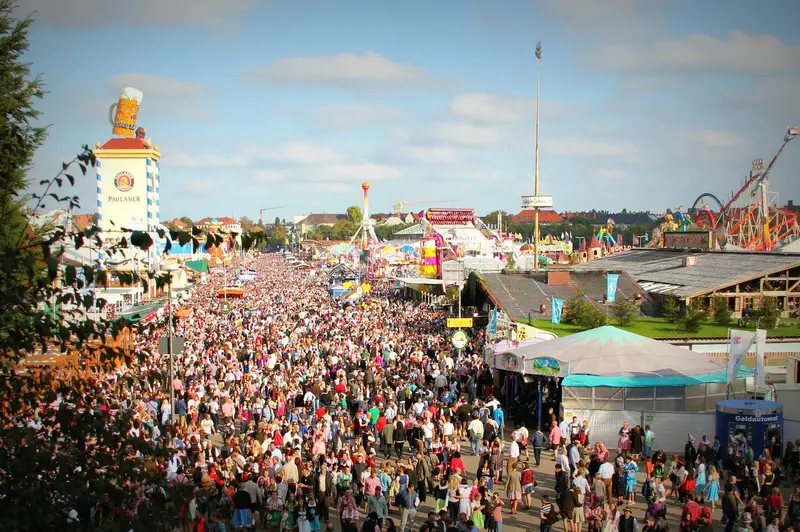
Oktoberfest is Munich’s two-week-plus folk festival on the Theresienwiese, the meadow named after a Saxon princess whose wedding started it all in 1810. Despite the name, most of it takes place in September: the city moved the start date forward in 1872 to catch the milder late-summer weather.
Origin: A Royal Wedding and a Horse Race
On October 12, 1810, Crown Prince Ludwig of Bavaria, the future King Ludwig I, married Princess Therese of Saxony-Hildburghausen, and marksmen were already on the meadow for the celebrations (Oktoberfest.de). The first Oktoberfest opened on October 17, 1810, with a large horse race outside the city gates, and the field was renamed “Theresienwiese” in the bride’s honour (muenchen.de). Locals still call the festival simply the Wiesn, “the meadow.”
The city’s own timeline shows how the party grew (muenchen.de):
- 1811: The Bavarian Agricultural Association decides to hold the festival again.
- 1813: Cancelled because of the Napoleonic Wars, the first of many gaps.
- 1818: The first carousel and two swings appear.
- 1819: The city of Munich takes over the organisation.
- 1850: The bronze Bavaria statue is unveiled above the meadow.
- 1854: Cancelled because of a cholera epidemic (wars also cancelled it in 1866 and 1870).
- 1872: The festival moves into September, starting on the Saturday after September 15.
- 1886: Electric light reaches the grounds.
- 1898: Georg Lang’s “Bierburg” becomes the first big festival tent, with room for 6,000.
- 1914–1918, 1923–1924, 1939–1945: No festival during the world wars and the inflation years.
- 1950: Mayor Thomas Wimmer taps the first keg with the cry “O’zapft is!” (“It’s tapped!”); it took him 17 blows.
- 1980: On September 26, a bomb at the main entrance kills 12 visitors and the attacker, and injures more than 200.
- 2010: The 200th anniversary adds the Oide Wiesn, a historic section with old rides.
- 2020–2021: Cancelled because of the Covid-19 pandemic.
The Munich Rituals, Day by Day
- Opening Saturday: the landlords’ entry. About 1,000 people, led by the tent hosts (Wiesnwirte) and the breweries, parade from Sonnenstraße via Schwanthalerstraße to the meadow (muenchen.de).
- Opening Saturday, 12 noon: the tapping. The Lord Mayor taps the first keg in the Schottenhamel tent. Twelve ceremonial gun salutes at the Bavaria statue then tell the other tents that beer may be served (muenchen.de).
- First Sunday, 10 a.m.: the costume and riflemen’s parade. Around 9,000 participants in about 50 groups of costume clubs, marksmen and bands walk nearly seven kilometres from the Max II Monument on Maximilianstraße to the Theresienwiese. It has been held on this day every year since 1950 and is organised by Festring München (Oktoberfest.de).
- Second Sunday, 11 a.m.: the brass-band concert. About 300 musicians play Bavarian and Alpine marches in front of the Bavaria statue; admission is free.
- Closing day, 12 noon: the Böllerschießen. Around 60 marksmen in costume fire ceremonial salutes below the Bavaria statue, with powder charges and no bullets (muenchen.de).
Only six Munich breweries supply the festival: Augustiner, Hacker-Pschorr, Hofbräu, Löwenbräu, Paulaner and Spaten. Beer is served by the Maß, a one-litre mug (muenchen.de).
Oktoberfests Elsewhere
- Kitchener-Waterloo, Ontario. Founded on October 14, 1969, by Richard Hermansen, Owen Lackenbauer and Darwin Clay, who had seen a small Bavarian festival at Kitchener’s Concordia Club. With a $200 budget, the first five days drew nearly 75,000 visitors. Its signature event is the Thanksgiving Day Parade on Weber Street, and guests in the festhallen sing “Ein Prosit” to polka bands (K-W Oktoberfest).
- Blumenau, Brazil. This city in the southern state of Santa Catarina held its first Oktoberfest in 1984. Planned for years, it gained momentum after a major flood, and the first edition drew about 102,000 people. It now runs for 19 days in October and opens, like Munich, by tapping the first keg (Oktoberfest Blumenau).
Planning a Visit: Dates, Costs and Rules
How the dates are set. The festival traditionally starts on the Saturday after September 15 and ends on the first Sunday in October. If October 3, German Unity Day, falls on a Monday, it runs to 17 days; if it falls on a Tuesday, the city council can extend it to 18 days (muenchen.de).
What the city’s visitor FAQ says (muenchen.de):
- Entry to the grounds is free; the Oide Wiesn, the historic section, charges a small entry fee.
- Beer prices are set each year and vary by tent and brewery; the city publishes them before the festival.
- Table reservations are made directly with each tent and go early. There is usually room without one, and beer gardens take no bookings.
- Traditional dress (dirndl or lederhosen) is not compulsory.
- Tuesdays are family day, with reduced prices until 7 p.m. Strollers are banned all day on Saturdays and October 3, and allowed until 6 p.m. on other days unless it is crowded.
Recipe: Obatzda (Bavarian Beer-Garden Cheese Spread)
Obatzda (“mashed together”) is the spread served with pretzels and radishes in Bavarian beer gardens. It takes 10 minutes and is better after an hour’s rest.
Ingredients (serves 4 to 6)
- 7 oz (200 g) ripe Camembert or Brie, at room temperature
- 2 tbsp (30 g) soft unsalted butter
- 3 1/2 oz (100 g) cream cheese
- 1 small onion or 2 shallots, very finely chopped
- 1 tsp sweet paprika, plus a little to dust
- 1/2 tsp caraway seeds, lightly crushed
- 2 to 3 tbsp light lager or wheat beer
- Salt and black pepper
- Chopped chives, to serve
Method
- Cut the Camembert into small pieces (keep the rind if it is soft) and mash it with a fork against the butter and cream cheese until mostly smooth but still a little chunky.
- Stir in the onion, paprika and caraway, then add beer a tablespoon at a time until the spread is soft but holds its shape.
- Season with salt and pepper, cover and chill for 1 hour.
- Mound it on a plate, dust with paprika, scatter with chives and serve with soft pretzels, sliced radishes and rye bread. It keeps 2 days in the fridge.
Messages
- “O’zapft is! Wishing you a happy Wiesn!”
- “Ein Prosit! Raising our steins to tradition, community and the spirit of Oktoberfest.”
- “May your beer be cold, your lederhosen comfortable and your Oktoberfest unforgettable!”
- “A Brezn, a bowl of obatzda and a seat in the beer garden: Prost from Munich!”
- “Happy Oktoberfest to everyone in Kitchener-Waterloo and Blumenau, keeping the Bavarian tradition alive far from home.”
- “Here’s to Ludwig and Therese, whose 1810 wedding party never really ended. Prost!”
Quotes
- “You can’t be a real country unless you have a beer and an airline. – Frank Zappa”
- “His Majesty was brought up on beer, and so were both his ancestors and officers. – Frederick the Great”
- “I adduce reasons to show that the manufacture of beer was the earliest art of primitive man. – James Death”
- “They drank this with a reed, out of the vessel that held the beer, upon which they saw the barley swim. – Xenophon”
- “Beer makes you feel the way you ought to feel without beer. – Attributed to Henry Lawson”
- “Good people drink good beer. – Attributed to Hunter S. Thompson”
- “A fine beer may be judged with only one sip, but it’s better to be thoroughly sure. – Unknown”
- “Hopfen und Malz, Gott erhalt’s! (Hops and malt, may God preserve them!) – Unknown”
FAQ
When is Oktoberfest 2027? Traditional Oktoberfest in Munich runs September 18 – October 3, 2027, though local celebrations may vary in timing.
Why is Oktoberfest in September? It began in October 1810, but in 1872 Munich moved the start to the Saturday after September 15 to make use of the milder weather (muenchen.de).
Who started Oktoberfest? It began as the celebration of Crown Prince Ludwig’s wedding to Princess Therese in October 1810. The Bavarian Agricultural Association repeated it in 1811, and the city of Munich has run it since 1819 (muenchen.de).
What does “O’zapft is!” mean? Bavarian for “It’s tapped!” The mayor shouts it after tapping the first keg at noon on the opening Saturday, a ritual begun by Thomas Wimmer in 1950.
Which beers are served? Only beer from Munich’s six festival breweries: Augustiner, Hacker-Pschorr, Hofbräu, Löwenbräu, Paulaner and Spaten (muenchen.de).
Do I have to wear a dirndl or lederhosen? No. The city says traditional dress is not compulsory, though many visitors wear it.
Can families with children go? Yes. Tuesdays are family day with reduced prices until 7 p.m., and there is a family area with children’s rides; strollers are not allowed on Saturdays or October 3.
Related Celebrations
Oktoberfest overlaps the Autumn Equinox and World Tourism Day on September 27. For more food and drink, see International Coffee Day and National Wine Day, and for folk music and dancing, World Music Day and International Dance Day.
Related holidays

September 15
Mid-Autumn Festival: History, Traditions
October 2
Rosh Hashanah: Traditions, Simanim, Honey Cake
February 9
Mardi Gras History, King Cake Recipe
September 6
Labor Day