
Tuesday, February 9, 2027 · in 92 days
Mardi Gras History, King Cake Recipe & Quotes 2027
Where Mardi Gras comes from, from Mobile's 1703 claim to the New Orleans krewes, how carnival is kept in Cajun Louisiana, Belgium, Switzerland and Colombia, a step-by-step king cake recipe, messages and quotes.
Updated 6 messages 9 quotes Tap to copy any message
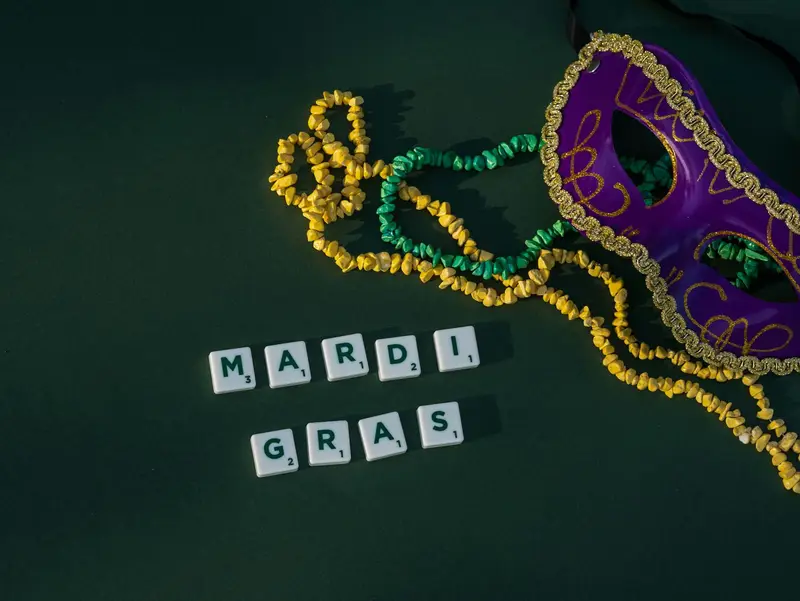
Mardi Gras, French for “Fat Tuesday,” is the last day of feasting before Lent begins on Ash Wednesday, and the climax of a Carnival season that starts on January 6. Its date moves with Easter, and the oldest American celebration was probably not in New Orleans at all: Mobile, Alabama, held a Mardi Gras in 1703, fifteen years before New Orleans was founded.
Origin: Mobile, New Orleans and the First Krewes
French explorers brought the feast to the Gulf Coast. Pierre Le Moyne d’Iberville and his younger brother Jean-Baptiste Le Moyne de Bienville reached the lower Mississippi on March 3, 1699, Fat Tuesday, and named the spot “Mardi Gras Point,” about 60 miles below present-day New Orleans (Louisiana America 250 Commission). In 1703 the settlement of Fort Louis de la Mobile held what even the New Orleans guide MardiGrasNewOrleans.com calls “America’s very first Mardi Gras,” and Mobile had a secret society, the Masque de la Mobile, from 1704 to 1709. Bienville did not found New Orleans until 1718 (Mardi Gras New Orleans).
The claim has caveats: the Mobile Carnival Museum’s curator, Cart Blackwell, notes that primary documents for the earliest years are thin. What is clear is that Mobile’s Cowbellion de Rakin Society, its first “mystic society,” set the format in the 1830s of a season of parades leading up to Mardi Gras Day (National Geographic).
Mobile also shaped New Orleans directly. Men who knew the Mobile parades created the city’s first Mardi Gras organisation, the Mistick Krewe of Comus, which put on its first parade in 1857 and began the city’s parading tradition (64 Parishes). Gaslight torches called flambeaux had already lit New Orleans processions since the late 1830s (Mardi Gras New Orleans).
Key dates after that:
- 1870: The Twelfth Night Revelers form, and their parade gives the first recorded account of Mardi Gras “throws.”
- 1872: Rex is created to preside over the first daytime parade, and purple, green and gold become the official colours, honouring the visiting Russian Grand Duke Alexis Romanoff: “Purple stands for justice; gold for power; and green for faith.”
- 1875: The Louisiana legislature passes the “Mardi Gras Act,” making Fat Tuesday a legal holiday in Louisiana (Mardi Gras New Orleans).
How Mardi Gras Is Kept
Zulu’s coconuts, New Orleans. The Zulu Social Aid and Pleasure Club, a Black benevolent society that also paid members’ funeral costs, traces its origins to 1909, when its founders paraded as a marching club; by 1912 to 1914 they had taken the Zulu name. Its riders hand out hand-decorated coconuts, a custom the club’s historians date to the early 1910s, and Louis Armstrong, who grew up near the first clubhouse, reigned as King Zulu in 1949 (Louisiana State Museum).
Joe Cain Day, Mobile. After the Civil War, Joe Cain revived Mobile’s carnival in 1866 by riding through downtown in a decorated charcoal wagon as a fictional Chickasaw chief, “Slackabamarinico.” On the Sunday before Fat Tuesday the People’s Parade still follows a costumed “chief” to Church Street Graveyard, where Cain’s “Merry Widows” mourn at his grave (Encyclopedia of Alabama).
Courir de Mardi Gras, Cajun Louisiana. In prairie towns such as Mamou, Eunice and Basile, masked riders in tall conical capuchons set out before dawn on horseback or trailers, led by an unmasked capitaine. They sing and clown at farmhouses, begging for “a little fat chicken,” rice, sausage or onions, often chasing live chickens donated for the evening’s communal gumbo (64 Parishes).
Carnival elsewhere. Three other pre-Lent carnivals are on UNESCO’s list of intangible heritage:
- Binche, Belgium. Over the three days before Lent, several hundred Gilles in red, yellow and black costumes, wax masks and ostrich-feather hats parade to drums on Mardi Gras and dance in the Grand Place (UNESCO).
- Barranquilla, Colombia. Four days before Lent of masked dances including the African-rooted congo and the Spanish paloteo (UNESCO).
- Basel, Switzerland. Basel starts late, on the Monday after Ash Wednesday, and runs for exactly 72 hours, with fife-and-drum “cliques” parading on Monday and Wednesday and lantern exhibitions on Tuesday (UNESCO).
King Cake: Season, Baby and Recipe
The custom of a cake for the Three Kings on January 6 came from France and Spain. In the late 1800s New Orleans’ Twelfth Night Revelers hid a bean in theirs, and whoever found it was crowned king or queen of the ball. In the 1940s baker Donald Entringer of McKenzie’s started baking small porcelain dolls, and later plastic babies, into his cakes; bakeries now leave the baby out of the oven and tuck it in afterwards. New Orleans bakeries sell king cake only from January 6 to Fat Tuesday (NPR). Today, by common custom, whoever gets the baby brings the next cake.
New Orleans-style king cake (serves 12 to 14; about 4 hours, mostly rising)
Dough
- 1/2 cup (120 ml) milk, warmed to about 110°F (43°C)
- 2 1/4 tsp (1 packet) active dry yeast
- 1/3 cup (65 g) sugar
- 3 large eggs, at room temperature
- 3 1/2 cups (440 g) all-purpose flour, plus extra for kneading
- 1 tsp salt
- 1/2 tsp ground nutmeg and 1 tsp grated lemon zest
- 1/2 cup (115 g) unsalted butter, softened
Filling
- 1/2 cup (100 g) packed brown sugar
- 1 tbsp ground cinnamon
- 4 tbsp (55 g) butter, very soft
Icing and topping
- 2 cups (240 g) powdered sugar, 3 to 4 tbsp milk, 1/2 tsp vanilla
- About 3 tbsp each of purple, green and gold sanding sugar
- 1 small plastic baby or a whole pecan
Method
- Stir the yeast and a pinch of the sugar into the warm milk and leave 5 to 10 minutes until foamy.
- Beat in the rest of the sugar and the eggs. Add the flour, salt, nutmeg and zest and mix to a shaggy dough, then work in the butter a tablespoon at a time.
- Knead 8 to 10 minutes (or 6 minutes with a dough hook) until smooth and slightly tacky. Cover and let rise in a warm place for 1 1/2 to 2 hours, until doubled.
- Roll the dough into a rectangle about 10 by 28 inches (25 x 70 cm). Spread with the soft butter, then sprinkle the brown sugar and cinnamon evenly, leaving a 1-inch border on one long edge.
- Roll up tightly from the other long edge, pinch the seam closed and bend the log into a ring on a lined baking sheet, pinching the ends together.
- Cover and let rise 45 to 60 minutes until puffy. Heat the oven to 350°F (175°C).
- Bake 25 to 30 minutes, until deep golden; an instant-read thermometer should show about 190°F (88°C) in the thickest part. Cool completely on a rack.
- Push the baby or pecan into the underside of the cooled cake, as New Orleans bakeries now do.
- Whisk the powdered sugar, milk and vanilla into a thick, pourable icing and spoon it over the top. While it is wet, sprinkle alternating bands of purple, green and gold sugar.
When Is Mardi Gras?
Mardi Gras is always the Tuesday 47 days before Easter Sunday, so it can fall anywhere from early February to early March. The New Orleans Carnival season opens on January 6 (Twelfth Night) and ends at midnight on Fat Tuesday, when Ash Wednesday begins (64 Parishes).
Messages
- “Laissez les bons temps rouler! Let the good times roll this Mardi Gras!”
- “Hope you find the baby in your king cake, and someone else buys the next one!”
- “Wishing you a ladder-side spot on the parade route and an armful of beads!”
- “Happy Fat Tuesday! One more beignet before Lent begins.”
- “May a Zulu coconut find its way into your hands this Mardi Gras.”
- “Happy Mardi Gras from Mobile, where it all began in 1703! Save us a Joe Cain Day spot.”
Quotes
- “For the soul of it is the romantic, not the funny and the grotesque. Take away the romantic mysteries, the kings and knights and big-sounding titles, and Mardi-Gras would die, down there in the South. – Mark Twain”
- “The largest annual event in New Orleans is a something which we arrived too late to sample—the Mardi-Gras festivities. – Mark Twain”
- “That’s what’s so wonderful about New Orleans. You can masquerade and Mardi Gras all year round if you want to. – John Kennedy Toole”
- “The purpose of life, after all, is to live it, to taste experience to the utmost, to reach out eagerly and without fear for newer and richer experience. – Eleanor Roosevelt”
- “A time to weep, and a time to laugh; a time to mourn, and a time to dance. – Ecclesiastes 3:4”
- “A man hath no better thing under the sun, than to eat, and to drink, and to be merry. – Ecclesiastes 8:15”
- “Laissez les bons temps rouler! (Let the good times roll!) – Unknown”
- “Life loves to be taken by the lapel and told: ‘I’m with you kid. Let’s go.’ – Attributed to Maya Angelou”
- “Joy is increased by spreading it to others. – Attributed to Robert Murray McCheyne”
FAQ
When is Mardi Gras 2027? Mardi Gras falls on Tuesday, February 9, 2027. The date changes each year as it’s calculated based on Easter.
Where was the first Mardi Gras in America? Mobile, Alabama, has the strongest claim: Fort Louis de la Mobile held a Mardi Gras in 1703, before New Orleans existed. Some historians caution that early records are thin (National Geographic).
What do the Mardi Gras colors represent? Rex adopted them in 1872; they stand for justice (purple), power (gold) and faith (green) (Mardi Gras New Orleans).
What is a krewe? A private club that stages a parade or ball. The first in New Orleans was the Mistick Krewe of Comus, which paraded in 1857 (64 Parishes).
Why is there a baby in a king cake? The token began as a bean that crowned the “king” of a Twelfth Night ball; McKenzie’s Bakery popularised porcelain and then plastic babies from the 1940s (NPR).
Related Celebrations
Mardi Gras ends where Lent begins and Lent leads to Easter. For Fat Tuesday’s Polish doughnuts, see National Donut Day; for brass bands and second lines, try World Music Day and International Dance Day. Another big parade day is St. Patrick’s Day.
Related holidays

October 2
Rosh Hashanah: Traditions, Simanim, Honey Cake
September 18
Oktoberfest History, Traditions
September 15
Mid-Autumn Festival: History, Traditions
February 9
National Pizza Day