
December 5–12, 2026 · in 26 days
Begins at sundown on Friday, December 4, 2026
Hanukkah: History, How to Light the Menorah, Latkes & Greetings 2026
Where Hanukkah comes from in the Books of Maccabees and the Talmud, how and when to light the menorah, how communities from Tunisia to Israel keep it, a latke recipe, plus messages and quotes.
Updated 6 messages 9 quotes Tap to copy any message
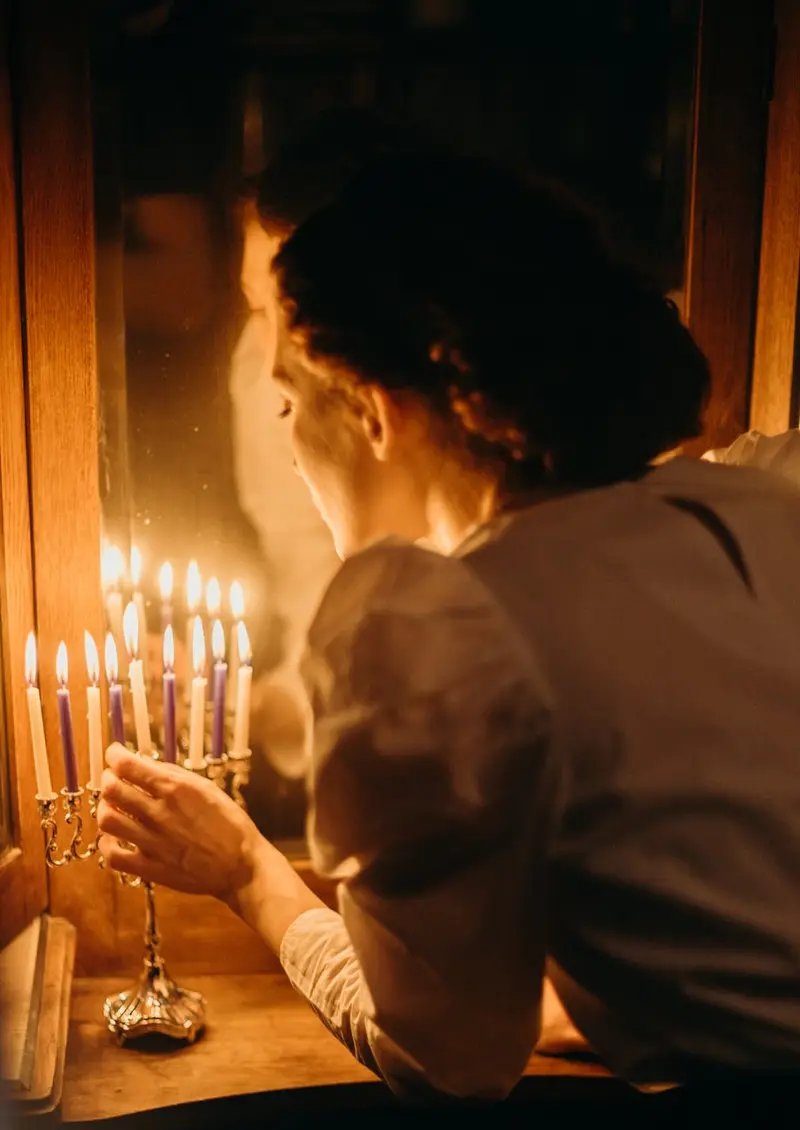
Hanukkah (“dedication”) is the eight-day Jewish festival that begins on the 25th of the Hebrew month of Kislev and recalls the rededication of the Temple in Jerusalem by the Maccabees. It is one of the few Jewish holidays not found in the Hebrew Bible: its story comes from the Books of Maccabees, and the famous miracle of the oil appears first in the Babylonian Talmud, written about 600 years after the events (My Jewish Learning).
Where Hanukkah Comes From
The revolt. Under the Seleucid king Antiochus IV Epiphanes, the Syrian Greeks pressed Hellenistic culture on Judea. By 167 BCE Antiochus had defiled the Temple and banned Jewish practice. The Maccabees, led by the five sons of the priest Mattathias and above all Judah, fought a three-year campaign that ended with the cleansing of the Temple (My Jewish Learning).
The rededication. The First Book of Maccabees says the new altar was dedicated “early in the morning on the twenty-fifth day of the ninth month, which is the month of Chislev”, that the people celebrated “for eight days”, and that Judah and the assembly decided the days should be kept “every year at that season” (1 Maccabees 4:52–59, NRSVUE). The Second Book of Maccabees explains the length: the eight days were celebrated “in the manner of the Festival of Booths”, the Sukkot the fighters had missed while hiding in the mountains and caves (2 Maccabees 10:1–8, NRSVUE). The rededication is usually dated to 164 BCE (My Jewish Learning).
The oil. The first-century historian Josephus called the holiday the Festival of Lights. The cruse of oil appears in Tractate Shabbat of the Babylonian Talmud, which asks “What is Hanukkah?” and answers that the Hasmoneans “searched and found only one cruse of oil that was placed with the seal of the High Priest”, enough for one day, which burned for eight (Sefaria, Shabbat 21b).
How to Light the Menorah
The Hanukkah menorah (hanukkiah) has eight lights in a row plus a ninth, the shamash (“helper”), set at a different height. A full set of nights uses 44 candles (My Jewish Learning).
- Count up, not down. On the first night light one candle, adding one each night until all eight burn on the last night. This follows Beit Hillel. Beit Shammai held the opposite, starting with eight and going down (Sefaria, Shabbat 21b).
- Place right to left, light left to right. Put the first candle in the right-most holder and add each night’s new candle to its left. Light the newest (left-most) candle first (My Jewish Learning).
- Say the blessings, then light. On the first night there are three blessings: l’hadlik ner shel Hanukkah (to kindle the Hanukkah light), she-asah nisim (who performed miracles for our ancestors) and Shehecheyanu. On the other nights say only the first two (My Jewish Learning).
- Use the shamash. In Ashkenazi practice the shamash is lit first and used to light the others. In Sephardi practice an extra candle lights the night’s candles and the shamash is lit last (My Jewish Learning).
- Put it where it can be seen. The Talmud’s ideal is the outside of the entrance to the house. Someone living upstairs uses a window facing the street, and in times of danger a table indoors is enough (Sefaria, Shabbat 21b).
Timing. Light after dark on ordinary nights. The Talmud sets the window as “until the traffic of the people of Tadmor ceases”, meaning until the market empties (Sefaria, Shabbat 21b). On Friday, light before the Shabbat candles while it is still light. On Saturday, light after Shabbat ends: Ashkenazi authorities differ on whether to do it before or after Havdalah, and most Sephardim make Havdalah first (My Jewish Learning).
How Hanukkah Is Kept Around the World
- Eastern Europe and the Ashkenazi diaspora: potato latkes. The earliest written record of Hanukkah pancakes is a 1322 poem by Rabbi Kalonymus ben Kalonymus. In Eastern Europe they were first made with buckwheat, rye or root vegetables and fried in schmaltz. Potato latkes became standard only after crop failures in Ukraine and Poland in 1839 and 1840 made potatoes cheaper than flour (My Jewish Learning).
- Italy: cheese pancakes. Gil Marks traced ricotta pancakes to a Hanukkah food in Italy that spread through Europe. The dairy link comes from the story of Judith, who fed the general Holofernes salty cheese and wine. By the 14th century Judith was associated with Hanukkah, and medieval Jews ate cheese in her memory (My Jewish Learning; BBC Religion).
- Israel: sufganiyot. Food historian Emelyn Rude traces fried Hanukkah fritters to a 12th-century Spanish rabbi. Polish Jews added jelly in the 16th century, and the jam doughnut became a national Hanukkah food in modern Israel under the name sufganiyah (“sponge”) (NPR). Israeli dreidels also differ: their letters stand for “a great miracle happened here”, not “there” (My Jewish Learning).
- Tunisia and North Africa: Chag HaBanot. On Rosh Chodesh Tevet, the new moon that falls during Hanukkah, Jewish communities in Tunisia (where the custom survived best), Libya, Algeria, Morocco, Istanbul and Thessaloniki kept the “Festival of Daughters”, linked to Judith and other heroic women (Hebcal).
- Gelt and the dreidel everywhere. Giving gelt (Yiddish for money) dates back at least to the Middle Ages. Today it is often chocolate coins in gold foil, which are also the usual stakes in dreidel games (BBC Religion).
Recipe: Classic Potato Latkes (about 16)
Ingredients
- 2 lb (900 g) russet potatoes, peeled
- 1 medium onion
- 2 large eggs, beaten
- 1/3 cup (40 g) matzo meal or plain flour
- 1 tsp salt and 1/4 tsp black pepper
- Neutral oil for shallow frying (about 1/4 inch / 6 mm deep)
- Applesauce and sour cream to serve
Method (about 45 minutes)
- Coarsely grate the potatoes and onion, using a box grater or the grating disc of a food processor.
- Pile them onto a clean tea towel, twist it closed and squeeze out as much liquid as you can. Dry potatoes make crisp latkes.
- Mix in the eggs, matzo meal, salt and pepper. Work quickly so the potatoes do not brown.
- Heat the oil in a heavy frying pan over medium-high heat until a shred of potato sizzles at once (about 350–375°F / 175–190°C).
- Drop in packed 1/4-cup mounds and flatten each to about 1/2 inch. Fry 3–4 minutes per side until deep golden.
- Drain on a rack or paper towels, salt lightly and keep warm in a 200°F (95°C) oven while you fry the rest. Add oil between batches as needed.
Hanukkah Messages
- “Happy Hanukkah! May the lights of the menorah bring warmth to your home and joy to your heart.”
- “Chag Hanukkah Sameach! May your dreidel spin toward good fortune and your sufganiyot be extra sweet.”
- “Hanukkah wishes! May your menorah shine bright and your latkes be perfectly golden.”
- “Happy Hanukkah! One more candle every night, until all eight burn together in the window.”
- “Happy Hanukkah! May the miracle of the oil remind you that even small lights can dispel great darkness.”
- “Wishing you a joyful Chag HaBanot to all the daughters, mothers and grandmothers this Hanukkah.”
Inspiring Quotes
- “Blessed are You, Lord our God, King of the universe, who has sanctified us by His commandments, and has commanded us to kindle the lights of Hanukkah. – Traditional Hanukkah blessing”
- “Blessed are You, Lord our God, King of the universe, who wrought miracles for our fathers in days of old, at this season. – Traditional Hanukkah blessing”
- “Not by might, nor by power, but by my spirit, saith the LORD of hosts. – Zechariah 4:6”
- “The spirit of man is the candle of the LORD. – Proverbs 20:27”
- “Still ours the dance, the feast, the glorious Psalm, the mystic lights of emblem, and the Word. – Emma Lazarus”
- “Just as Hanukkah candles are lighted one by one from a single flame, so the tale of the miracle is passed from one man to another, from one house to another, and to the whole House of Israel throughout the generations. – Judah L. Magnes”
- “The miracle, of course, was not that the oil for the sacred light in a little cruse lasted as long as they say; but that the courage of the Maccabees lasted to this day. – Charles Reznikoff”
- “A candle is a small thing. But one candle can light another. And see how its own light increases, as a candle gives its flame to the other. – Attributed to Moshe Davis”
- “A little bit of light dispels a lot of darkness. – Unknown”
Frequently Asked Questions
When is Hanukkah 2026? Hanukkah 2026 begins at sundown on Friday, December 4, 2026 and ends at nightfall on Saturday, December 12, 2026. The festival lasts for eight days and nights.
Why does the date change every year? Hanukkah is fixed in the Hebrew calendar, starting on 25 Kislev, but the Hebrew calendar is lunisolar, so in the Western calendar it falls in November or December (BBC Religion). Like all Jewish days it starts at sundown, so the first candle is lit on the evening before the first full day.
Why eight days? The Books of Maccabees say the rededication was celebrated for eight days in the manner of Sukkot, the festival the fighters had been unable to keep (2 Maccabees 10:6). The Talmud explains it with the one-day cruse of oil that burned for eight (Sefaria, Shabbat 21b).
Why are fried foods and dairy eaten at Hanukkah? Fried foods such as latkes and sufganiyot recall the oil. Dairy recalls Judith, who fed the enemy general cheese and wine before beheading him (BBC Religion).
What do the letters on a dreidel mean? The four Hebrew letters (nun, gimel, hei, shin) stand for Nes gadol haya sham, “A great miracle happened there”. In Israel the shin is replaced by a peh, for po, “here”. In the game, nun means take nothing, gimel take the whole pot, hey take half, and shin or peh put one in (My Jewish Learning).
What should I say to someone celebrating Hanukkah? “Happy Hanukkah” or “Chag Sameach” (“happy holiday”) are both standard. Chocolate gelt, candles, or a dreidel for the children make good small gifts.
Related Celebrations
As you plan your Hanukkah celebration, you might also enjoy exploring our guides for Diwali, the Hindu Festival of Lights, Christmas, Winter Solstice traditions, and National Donut Day.
Related holidays

December 5
International Volunteer Day
December 5
World Soil Day
December 3
International Day
December 2
World Computer Literacy Day